The gaming industry is rapidly evolving, with NFT game trends leading this digital shift. By 2026, NFT gaming will have moved beyond hype to become sustainable ecosystems where players own, trade, and earn from digital assets like items, land, collectibles, and avatars. This change grants real ownership and financial power to millions of gamers.
The NFT gaming market is expected to hit $1.08 trillion by 2030, growing at 14.84% CAGR from 2025. This growth shows the industry’s shift from experiments to utility-driven platforms focused on player value and sustainable economics over short-term profits.
For developers and investors, staying current with the latest NFT game trends is essential for creating projects that attract passionate players and deliver meaningful real-world value. Let’s explore the top trends shaping NFT gaming in 2026, from ownership and trading to rewards, and discover how partnering with a dedicated game development company can help turn these innovative ideas into reality.
1. True Digital Ownership Through Blockchain Assets
The key trend in NFT games is authentic ownership of digital assets, with players holding verifiable blockchain records for their items. Unlike traditional games where assets disappear when servers close, NFTs stay on-chain, offering players true control.
Leading game development services providers are creating NFTs that function across different games and virtual worlds. For example, a rare sword earned in one blockchain game could be displayed in a virtual metaverse or traded on an NFT marketplace in gaming platforms outside the original game ecosystem.
This change boosts player trust, increases long-term engagement, and creates new revenue via resale royalties. Cross-game asset interoperability shifts how players see value in gaming, as investments move beyond individual titles into a broader digital economy.
2. Evolution from Play-to-Earn to Play-and-Earn
The Play-to-Earn (P2E) model initially showed people that gaming could be a viable income source. However, early versions focused too heavily on earning mechanisms at the expense of entertainment, leading to unsustainable token economies. By 2026, a new trend called Play-and-Earn (P&E) has emerged as one of the most significant NFT game trends, prioritizing engaging gameplay while integrating earning opportunities naturally.
Expert play-to-earn games development teams are now adopting balanced tokenomics, skill-based earning models, and utility-focused rewards. This shift moves away from simple token inflation that plagued earlier projects. Games like Axie Infinity (with its revamped 2026 model), Illuvium, and Gods Unchained show that rewarding players for skill, engagement, and creativity sustains vibrant, sustainable P2E economies.
The GameFi sector’s market cap has seen renewed interest in 2026, with weekly NFT sales rising over 30% to $85 million in early 2026, signaling a market rebound. This growth reflects players’ preference for games that deliver quality experiences first, with crypto rewards serving as meaningful enhancements rather than the sole attraction.
3. Cross-Game Asset Interoperability
Among the most exciting NFT game trends is cross-game asset interoperability, the ability to use your digital items across multiple gaming experiences. Imagine your avatar, vehicle, or weapon functioning seamlessly in various games, virtual worlds, or VR environments. This represents the next evolution in digital ownership.
Developers are implementing standards like ERC-721 and ERC-1155 to ensure NFTs work across different platforms. These technical standards enable assets to maintain their value and utility regardless of where they’re used. Projects like Enjin are developing Software Development Kits (SDKs) that simplify the process for developers using engines like Unity or Unreal to implement interoperable items.
The result is a more immersive, interconnected gaming universe where players maintain a consistent identity across digital worlds. This interoperability extends to NFT marketplace in gaming platforms, allowing seamless trading of assets that hold value across multiple titles. Major platforms like Decentraland and The Sandbox are already building their virtual worlds with this principle in mind.
4. Dynamic NFTs for Interactive Progression
Dynamic NFTs (dNFTs) represent one of the most innovative NFT game trends, transforming static collectibles into living assets that evolve with player achievements. These intelligent NFTs change based on gameplay actions and external data, creating assets that genuinely reflect a player’s journey.
Examples of dynamic NFT applications include:
- Swords that level up with victories, displaying battle statistics
- Digital pets that grow and change appearance based on care and interaction
- Racing vehicles that improve performance through competition
- Characters whose appearance and abilities adapt to environmental factors
Around 30% of new NFT projects in 2025 incorporated AI elements, ranging from generative art to autonomous in-game agents. Intelligent NFTs (iNFTs) combine blockchain provenance with AI adaptability, creating assets that can evolve visually, change behaviors based on user interactions, or even generate content autonomously.
Professional NFT game development services can embed smart contracts that adjust attributes in real-time, enhancing engagement and encouraging players to invest more time and effort into developing their unique digital assets.
5. Integration with Metaverse Ecosystems
NFT gaming’s integration with the metaverse represents a major shift in how we perceive digital spaces. This convergence creates immersive online worlds where people can socialize, collaborate, and trade assets seamlessly. Games like The Sandbox and Decentraland exemplify this trend, allowing players to purchase virtual land, create experiences, and earn rewards through content creation.
By 2026, metaverse-linked NFT games are fueling a new wave of digital entrepreneurship. Fortune 500 companies are allocating dedicated budgets to metaverse initiatives, viewing these virtual worlds as essential business infrastructure rather than experimental playgrounds. Brands and creators leverage these environments to launch products, host events, and collaborate within games, transforming virtual spaces into thriving economic hubs.
The metaverse gaming market is expected to reach $800 billion, with NFTs serving as the backbone for ownership, commerce, and identity verification across these interconnected digital realms.
6. DAO Governance and Community-Led Economies
Decentralized Autonomous Organizations (DAOs) give players unprecedented opportunities to shape their favorite games’ futures. This represents one of the most empowering NFT game trends, transforming players from passive consumers into active stakeholders.
More NFT gaming projects are adopting governance tokens, allowing players to vote on:
- Game updates and feature implementations
- In-game events and seasonal content
- Economic policy changes and reward distribution
- Community initiatives and partnerships
This community-led governance promotes loyalty, transparency, and sustainable P2E economies. Instead of acting solely as consumers, players become stakeholders who influence project development, creating deeper emotional and financial investment in the game’s success.
7. Enhanced Marketplace Liquidity and Cross-Chain Trading
By 2026, NFT marketplaces on gaming platforms have evolved, with liquidity and cross-chain support crucial for success. Players demand instant trades, low fees, and compatibility across Ethereum, Polygon, Solana, and BNB Chain.
Ethereum continues to dominate with 62% of NFT contracts and 45% of NFT trading volume in 2025, though Polygon is surging due to its lower transaction costs and faster speeds. Layer-2 scaling solutions have slashed transaction costs by up to 99% compared to the Ethereum mainnet while maintaining security standards.
Professional custom NFT marketplace development services are integrating decentralized marketplaces and multi-chain bridges that allow NFTs to flow freely between networks. This trend reduces barriers for users, increases transaction volume, and boosts revenue for developers through secondary royalties.
Magic Eden has evolved from a Solana-focused platform into a multichain NFT marketplace, cementing its dominance in gaming and entertainment-based assets. By 2026, it will serve as a central point for in-game NFT economies where both indie and AAA studios tokenize characters, weapons, and assets for seamless trading.
8. AI-Driven Personalization and Smart NFTs
Artificial Intelligence integration represents one of the most cutting-edge NFT game trends, offering personalized experiences and intelligent in-game assets. AI-driven NFTs adapt in real-time to player actions, producing unique outcomes for every user.
Examples of AI-powered NFT applications include:
- AI companions that adapt to a player’s combat style and preferences
- NPCs that generate custom quests based on individual player performance
- Dynamic environments that evolve according to community actions
- Generative art NFTs that create unique variations for each owner
This personalization encourages long-term engagement and emotional bonds with digital assets, essential for player retention in competitive Web3 environments. AI-curated NFT collections now use algorithms to create personalized art, while on-chain AI agents leverage NFTs for identity and autonomous task execution.
Market Growth and Industry Statistics for 2026
The NFT game trends we’ve discussed are supported by impressive market data:
- Market Size: The global NFT gaming market is valued at $540 billion in 2025, projected to reach $1.08 trillion by 2030 at a 14.84% CAGR
- Gaming Dominance: Gaming NFTs capture 38% of total NFT transaction volume in 2026, the largest category
- User Growth: The NFT market is expected to reach 11.67 million users by 2026
- Regional Leadership: North America contributed 38.2% of global revenue in 2024, while Asia-Pacific showed the fastest growth at 16.98% CAGR
- Transaction Recovery: Weekly NFT sales surged over 30% in early 2026 to $85 million, signaling market recovery
- Blockchain Distribution: Ethereum maintains 62% of NFT contracts, with Polygon emerging as a strong competitor for gaming applications
These statistics demonstrate that while the market has matured from its 2021 peak, it’s building a sustainable foundation focused on utility, genuine gameplay quality, and long-term value creation rather than speculation.
Building Sustainable NFT Gaming Economies
Creating sustainable P2E economies requires careful planning and execution. The most successful projects in NFT game development in 2026 share several key characteristics:
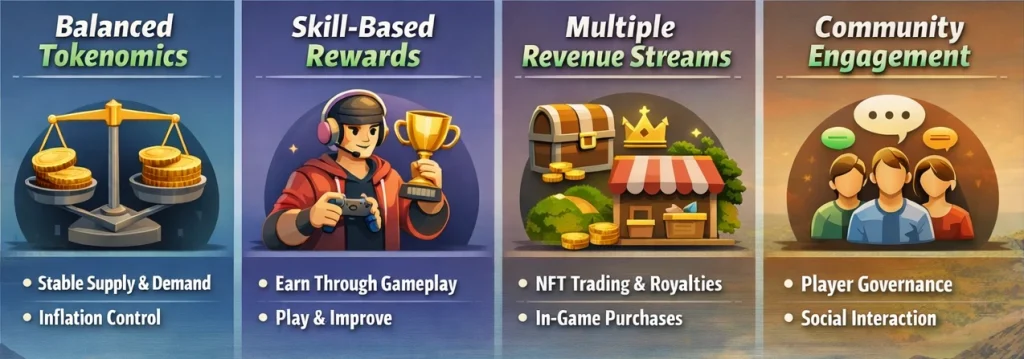
Balanced Tokenomics
Games must implement dual-token systems that separate governance tokens from utility tokens. This prevents inflation while maintaining player rewards. Axie Infinity’s 2026 reforms, including the introduction of bAXS rewards and halting SLP emissions, reduced inflationary pressure by over 30%, stabilizing the ecosystem.
Skill-Based Rewards
Rather than rewarding simple participation, successful games reward skill, strategy, and meaningful contributions. Gods Unchained exemplifies this approach, where competitive play determines rewards rather than mindless grinding.
Multiple Revenue Streams
The Sandbox demonstrates how virtual real estate can generate income through appreciation, rentals, and user-generated content. The SAND token’s 2026 market cap of $420 million facilitates governance, staking, and marketplace transactions, offering diversified earning pathways.
Community Engagement
Active communities drive long-term success. Games with vibrant Discord servers, regular developer updates, and community-driven events maintain higher player retention and more stable economies.
Conclusion
NFT game trends shaping 2026 mark a transformation in digital entertainment, from true asset ownership and cross-game interoperability to sustainable P2E economies and AI-driven personalization, empowering players.
NFT gaming has matured from speculative hype to utility-driven platforms, focusing on engaging gameplay, balanced economics, and real value instead of short-term pumps. As NFT marketplaces become more advanced and cross-chain solutions break barriers, a connected digital economy is emerging.
For studios and entrepreneurs ready to enter this space, partnering with an experienced game development company makes all the difference. With expertise in blockchain integration, smart contract development, and tokenomics design, BR Softech helps build scalable, secure, and engaging NFT games that empower players and generate lasting value.
Frequently Asked Questions (FAQs)
What are the latest NFT game trends in 2026? The biggest NFT game trends in 2026 include true digital ownership through blockchain assets, Play-and-Earn models prioritizing gameplay quality, cross-game asset interoperability, dynamic NFTs that evolve with player actions, DAO-driven community governance, AI-powered personalization, and enhanced cross-chain marketplace functionality. These innovations focus on creating sustainable, player-centric ecosystems rather than speculative token economies.
How do NFTs enhance player ownership in games? NFTs provide true ownership of in-game assets such as characters, skins, land, and collectibles. These assets exist permanently on the blockchain, meaning players can freely trade, sell, or transfer them even if the original game shuts down. This represents a fundamental shift from traditional gaming, where all assets are controlled by game publishers and have no value outside their specific game ecosystem.
What is the difference between Play-to-Earn and Play-and-Earn? Play-to-Earn (P2E) focuses primarily on generating income through gameplay, often at the expense of entertainment value. Play-and-Earn (P&E) prioritizes engaging, quality gameplay first, with balanced economic rewards integrated naturally. P&E creates more sustainable ecosystems by attracting players who genuinely enjoy the game, ensuring long-term retention beyond just financial incentives.
Are NFT games still profitable for businesses in 2026? Yes, NFT games remain highly profitable in 2026, particularly those focusing on genuine player ownership, cross-game interoperability, and fair reward systems. The market is projected to reach $1.08 trillion by 2030. Games that combine engaging gameplay with transparent blockchain economics see stronger user retention, higher lifetime value, and multiple revenue streams, including primary sales, marketplace fees, royalties, and token appreciation.
How does cross-game asset interoperability work? Cross-game asset interoperability allows NFTs to function across multiple gaming platforms and virtual worlds. This is achieved through standardized blockchain protocols like ERC-721 and ERC-1155, which ensure assets maintain their properties regardless of platform. Developers create integration systems where a weapon, character, or item from one game can be recognized and utilized in another, significantly increasing the utility and value of digital assets for players.